
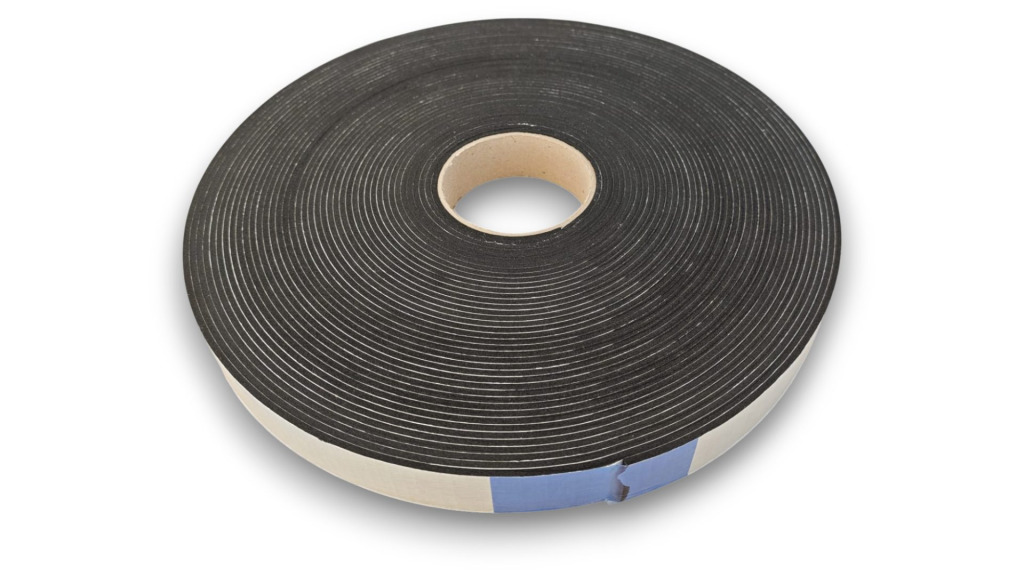
EPDM self-adhesive sealing tape – 3 mm × 30 mm × 25 m
Self-adhesive closed-cell EPDM rubber sealing tape with a wide range of uses in construction and roof installation. Its main use is to be stuck onto battens before fixing the roof sheet, so that nails and screws go through the tape rather than straight into the batten, and no water entry points form at the fixing points. The tape is also useful for any sealing job that needs a flexible, waterproof and durable rubber seal. EPDM is one of the most durable types of rubber in construction – which is why it is used in car interiors, roof waterproofing and industrial manufacturing.
Main properties
- Material: Closed-cell EPDM foam rubber – waterproof, flexible, chemically resistant
- Thickness: 3 mm
- Width: 30 mm
- Roll length: 25 m
- Colour: Black
- Fixing: Self-adhesive – glass-fibre acrylic adhesive layer, protected with a removable liner
- Density: 130–170 kg/m³
- Water absorption: < 2%
- Temperature resistance: −40 °C to +90 °C (without the adhesive layer); up to +60 °C with the self-adhesive layer
- Recommended application temperature: +5 °C to +25 °C
Use
Under battens in roof installation – the tape is stuck along the top of the batten before the roof sheet or tiles are fixed. When a nail or screw is driven through the sheet, it also goes through the tape and the batten. The EPDM rubber compresses around the fixing point and seals the hole, keeping water out even in heavy rain.
General sealing – the tape can also be used for sealing windows, doors, hatches and gates, insulating various building joints, fixing facade cladding to the frame, and for noise, air, heat and moisture insulation in foundations, load-bearing structures and other elements.
Why EPDM?
EPDM (ethylene propylene diene monomer) is a synthetic rubber used where ordinary PE or PU foam is not good enough. Its main advantages:
- Resistance to UV radiation and ozone – one of the best among rubber types. It does not become brittle or crack, even after years in direct sunlight.
- Wide temperature range – works in the cold of a Latvian winter (−40 °C) and on a hot summer roof (+90 °C).
- Closed cells = waterproof – unlike open-cell foam, closed-cell EPDM does not absorb moisture and keeps sealing even in prolonged contact with water.
- Elasticity and spring-back – it recovers its shape after compression. This means the seal stays in contact with both surfaces even if the structure moves slightly or its dimensions change with temperature.
- Resistance to mild chemicals – it does not react with most substances used in construction.
- Long service life – EPDM is used in the automotive, industrial and construction sectors precisely because its service life is measured in decades, not years.
Contact our specialists about availability and price.

